Your Brain on Agency
What fMRI predictions reveal about five ways of getting stuck, and the two ingredients of agency
There's a question at the heart of Nervous System Mastery that's always been hard to answer with data: what actually changes in the brain when someone shifts from a stuck pattern into a high-agency state?
George Mack defines high agency as three things working together: clear thinking, bias to action, and disagreeability. His test is simple: you wake up in a jail cell in a foreign country. Who do you call? That person has high agency.
We wanted to see what that looks like in the brain. Meta's TRIBE v2 model, trained on the Human Connectome Project dataset1 (1,758 subjects, 15 hours of fMRI each), predicts whole-brain activation patterns from audio input alone. Feed it speech, and it returns vertex-wise predictions across 181 brain regions.
1 The HCP is the largest standardized fMRI dataset ever collected. TRIBE v2 was trained on 26,000+ hours of combined neural recording data.We designed a simple experiment: take the same scenario, narrate it five different ways, and see what the brain predictions look like.
The Jail Cell Test
The scenario: you wake up in a locked room. Phone has no signal. Water bottle half full. A pen. Small window. Locked door.
Same facts. Same constraints. Five different internal narrations, each representing a distinct agentic stance:
Flat, unclear, unfocused. No orientation, no action.
"I don't know. I'm in some room. There's a door I think. And a window maybe. I have some stuff. I don't really know what's going on. I guess I should do something but I'm not sure what..."
What-if loops, mental spinning, paralysis through overthinking.
"Oh god. How did I get here? What if someone locked me in? What if no one knows where I am? What if my phone never gets signal? What if the water runs out? I should have been more careful..."
Overcomplicates, theorizes, analyzes without acting.
"Interesting. So the room dimensions suggest this is roughly twelve by fourteen feet. The window appears to face north based on the light angle... I should create a decision matrix weighing escape probability against the risk of alerting whoever put me here..."
Too much input, system flooding, freeze response.
"Oh my god. This is too much. I can't. My heart is pounding. There's so much I need to figure out and I can't think straight. The walls feel like they're closing in. My hands are shaking..."
Clear thinking, bias to action. Assess, decide, move.
"Okay. I'm in a room. Locked door. Small window. Half a water bottle, a pen, no signal. I don't know how I got here but that doesn't matter right now. What matters is getting out. Let me think about what I have to work with. Door's locked ~ can I see the hinges? What's the window frame made of? The pen could work as a tool. Let me check the door first. If that doesn't work, the window. One thing at a time. Door first. Let's go."
Each narration was converted to speech and fed through TRIBE v2. The model returned predicted brain activation across 20,484 cortical vertices, which we grouped into eight regions of interest: insula (interoception), ACC/mPFC (salience), dlPFC (executive control), DMN (default mode), somatosensory, motor/premotor, temporal/language, and posterior parietal.
The Brain Maps
Predicted activation patterns for all five stances. Red/warm = positive activation. Blue/cool = suppression.
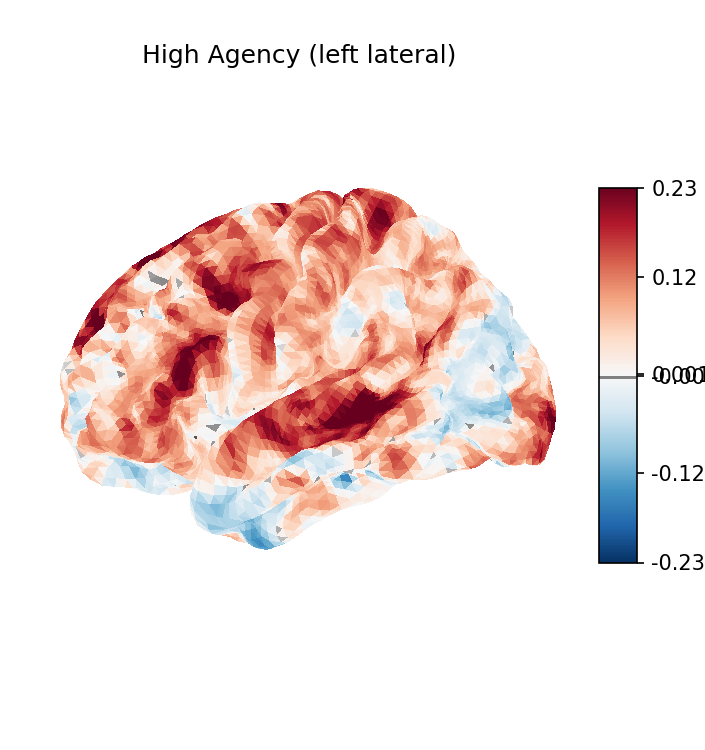
High Agency
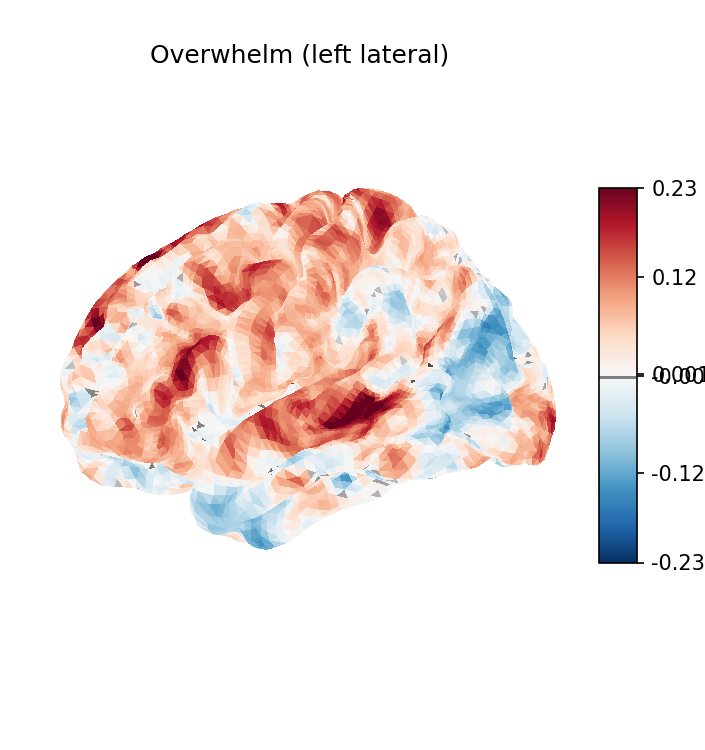
Overwhelm
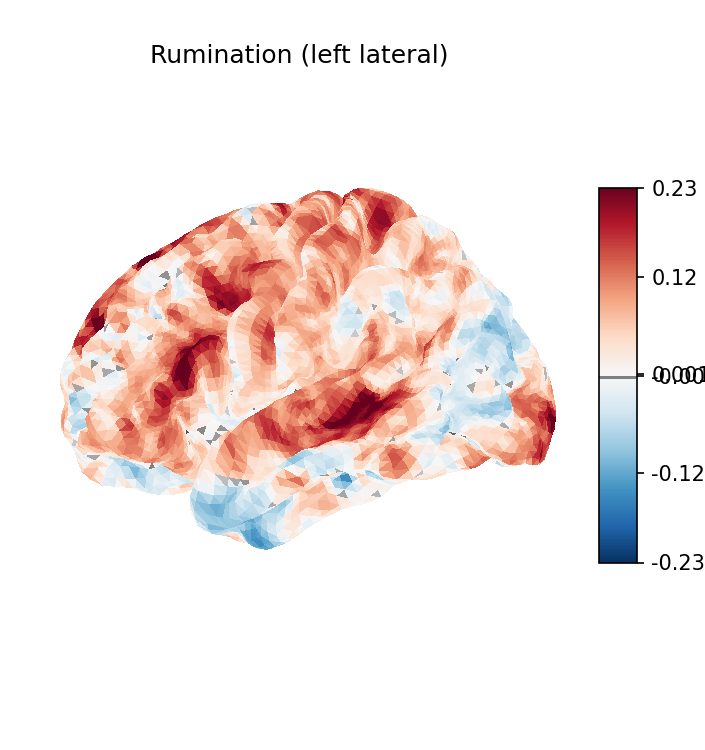
Rumination
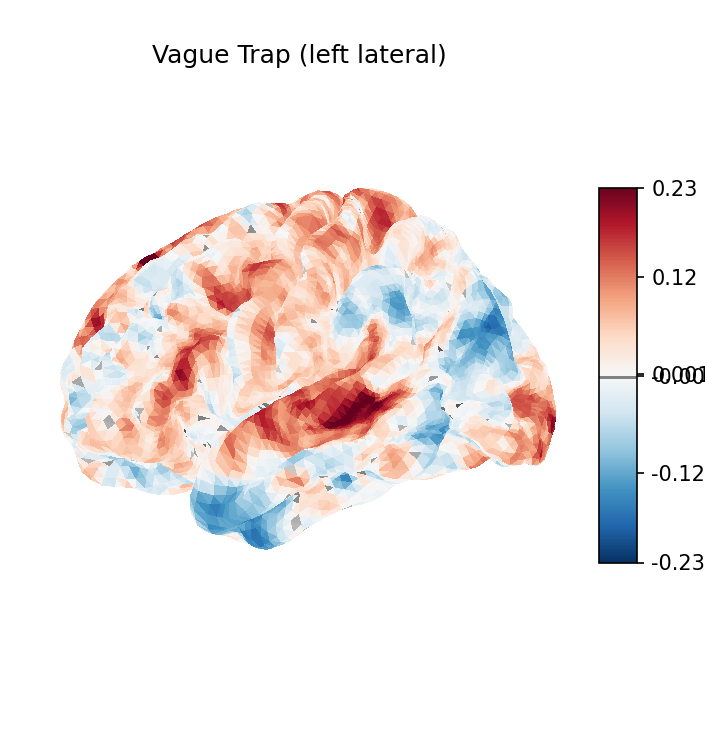
Vague
The differences are visible at a glance. Overwhelm shows the most blue. High agency and rumination show the most red. But the distributions are different. Let's look at what happens when we subtract.
Difference Maps
These maps show where high agency activates more (red) or less (blue) than each trap.
High Agency vs. Overwhelm
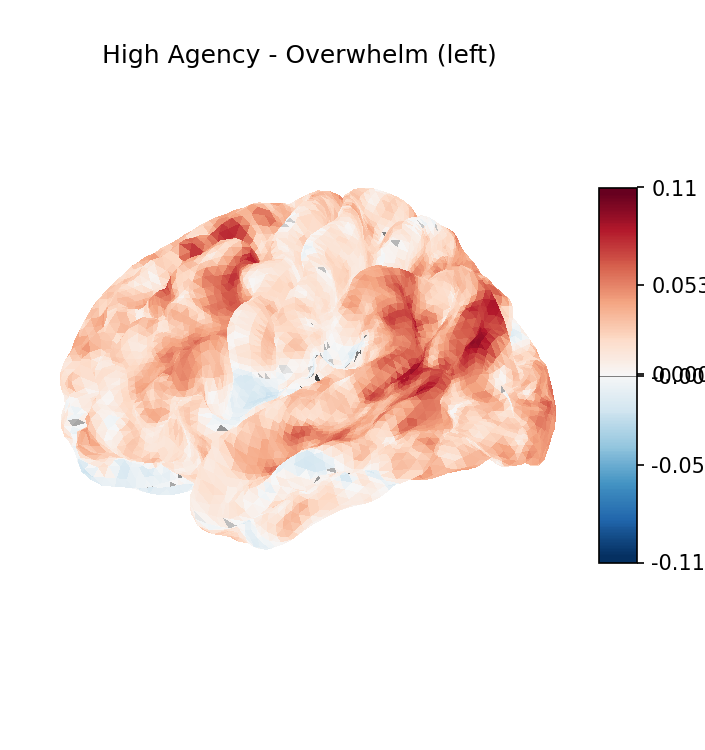
Left hemisphere
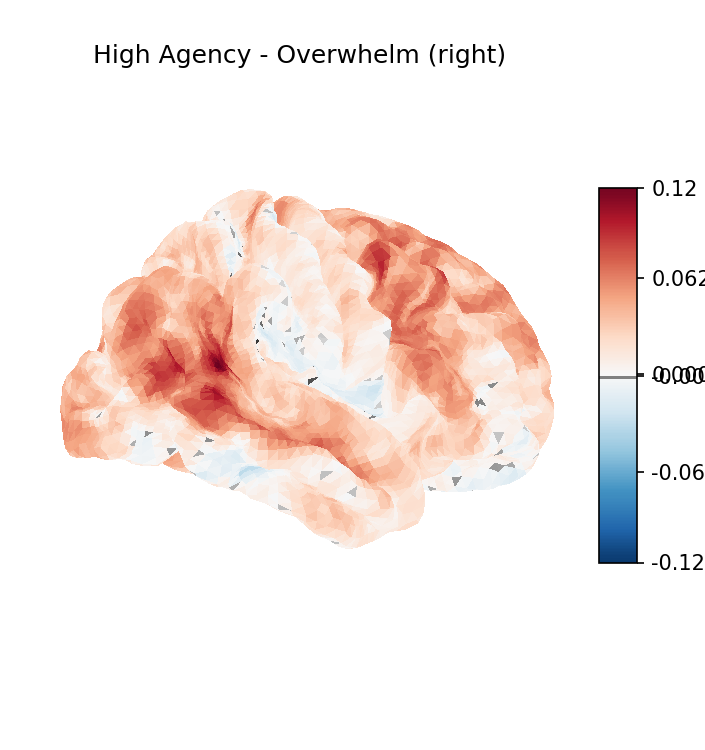
Right hemisphere
Nearly all red. High agency dominates every region. The overwhelm state shows broad cortical suppression2, consistent with what polyvagal theory describes as a dorsal vagal shutdown. The brain isn't just thinking differently during overwhelm. It's going offline.
High Agency vs. Vague Trap
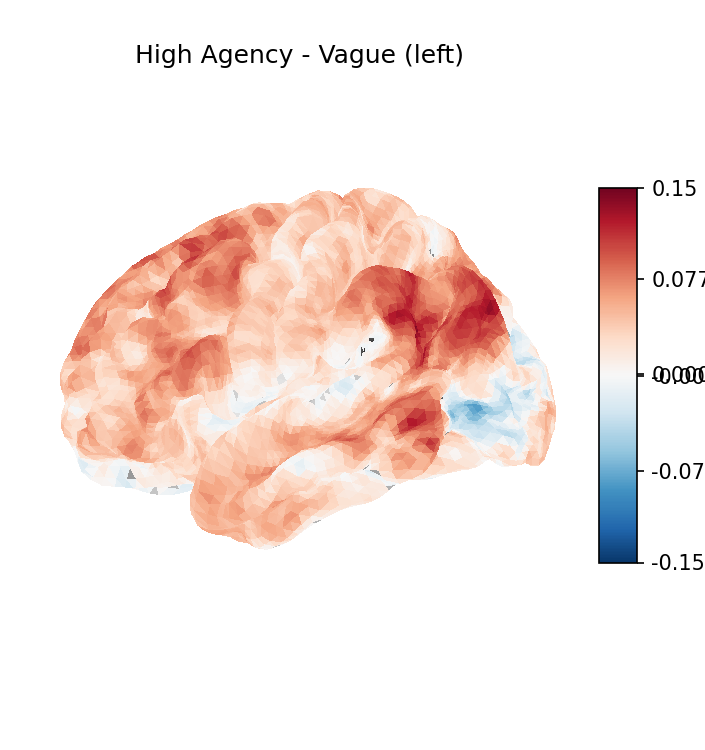
Left hemisphere
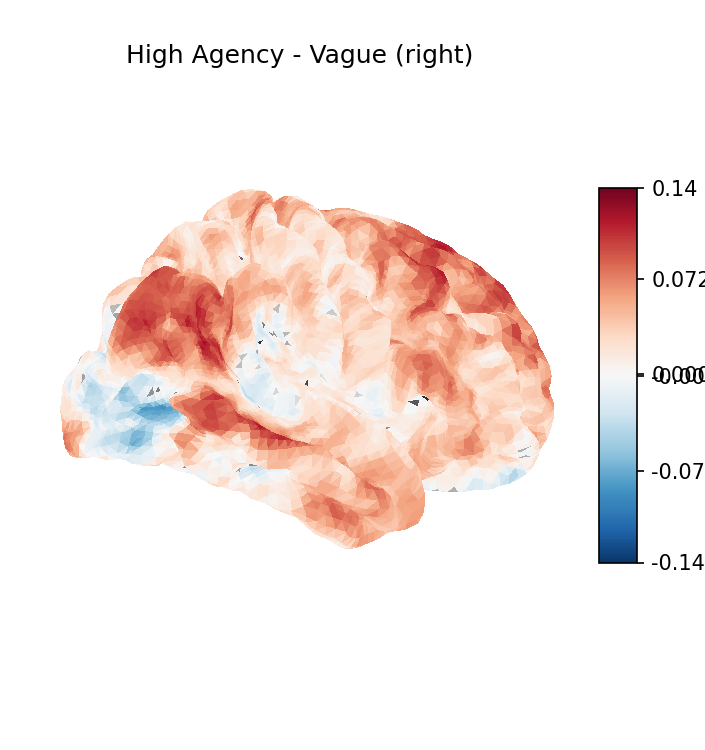
Right hemisphere
A striking dorsal-ventral split. High agency leads in superior frontal and parietal regions (top-down control). But the vague trap actually exceeds high agency in temporal and inferior parietal areas ~ the regions associated with diffuse semantic processing. Vagueness may involve excessive associative processing without executive direction.
High Agency vs. Rumination
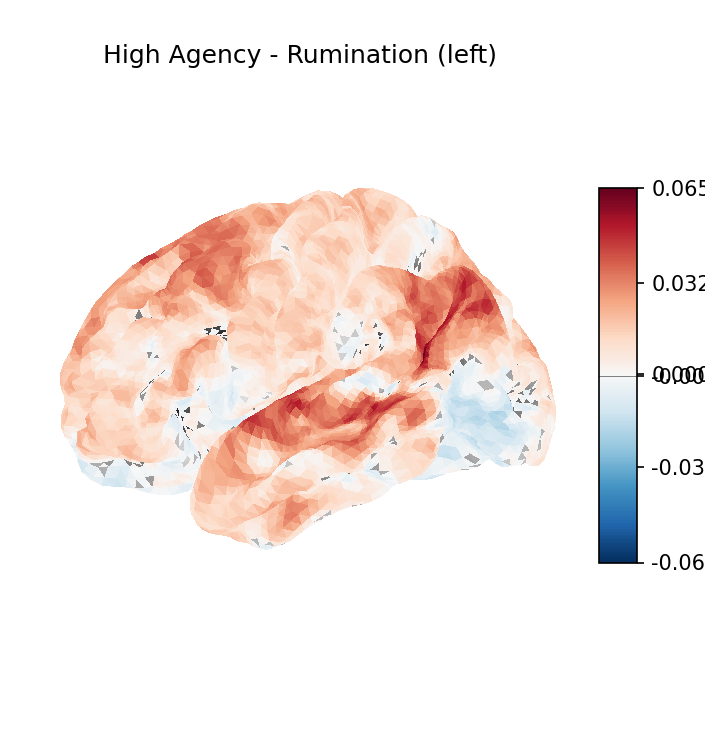
Left hemisphere
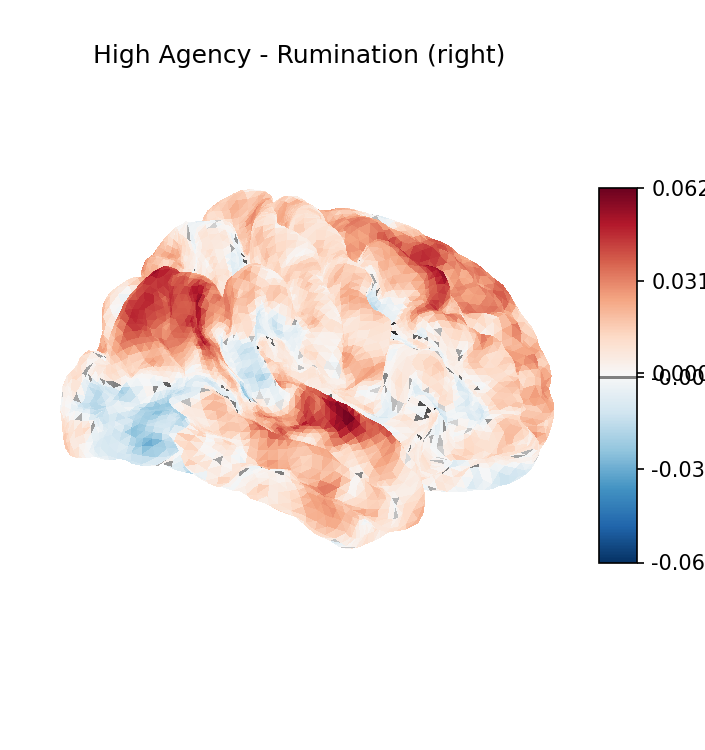
Right hemisphere
The most muted difference map. These two stances are neurally similar ~ closer than any other pairing. The small differences are concentrated in motor/premotor and temporal regions, where high agency pulls ahead. The ruminating brain is running hot ~ it's not a lack of activation, it's a redirection. The energy that could power action is instead powering what-if language loops.
High Agency vs. Midwit Trap
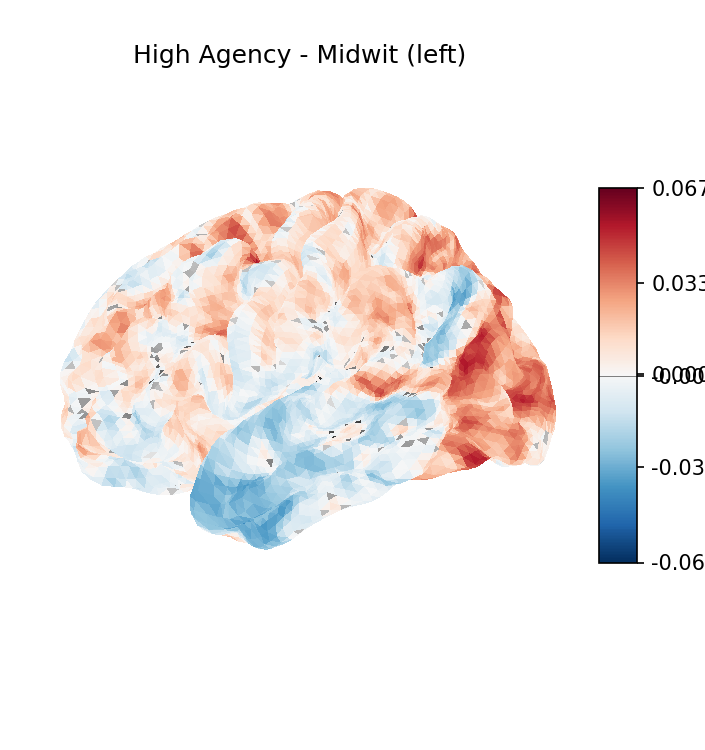
Left hemisphere
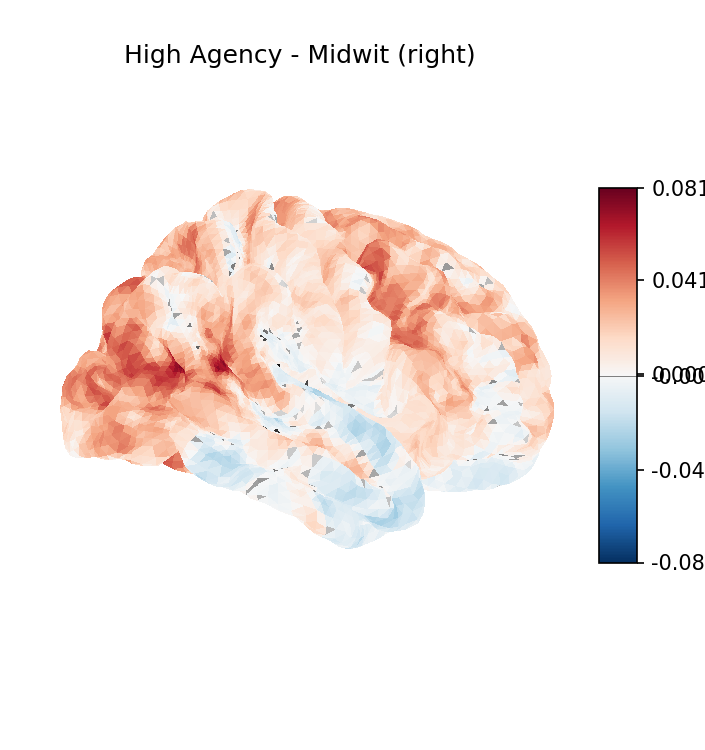
Right hemisphere
Similar to the vague trap pattern but milder. The midwit trap has the highest peak dlPFC activation of any stance (0.369 max) but doesn't sustain it. Bursts of executive activity that go nowhere. Analysis without integration.
The Numbers
Mean activation across eight regions of interest, measured as predicted BOLD signal change:
| Stance | Insula | ACC | dlPFC | DMN | Somato. | Motor | Temporal | Parietal |
|---|---|---|---|---|---|---|---|---|
| High Agency | +.033 | +.066 | +.083 | -.007 | +.083 | +.109 | +.132 | +.050 |
| Rumination | +.031 | +.055 | +.062 | -.027 | +.071 | +.096 | +.117 | +.038 |
| Midwit | +.027 | +.053 | +.065 | -.028 | +.076 | +.092 | +.124 | +.032 |
| Vague | +.019 | +.023 | +.024 | -.050 | +.051 | +.070 | +.086 | +.009 |
| Overwhelm | +.027 | +.038 | +.044 | -.045 | +.070 | +.081 | +.090 | +.024 |
Five Findings
1. Agency is a whole-brain state
High agency doesn't just light up the prefrontal cortex. It shows the strongest activation of any stance in every single region of interest: motor/premotor (+0.109), temporal/language (+0.132), dlPFC (+0.083), somatosensory (+0.083), ACC (+0.066), and posterior parietal (+0.050). These are action-planning, language, executive control, and spatial-awareness regions all working together.
The high-agency narrator isn't doing anything somatic. No breathwork, no grounding. Just: assess the situation, identify resources, pick a first action, go. The predicted brain pattern shows a system ready to move.3
3 Motor/premotor cortex (+0.109) and temporal/language (+0.132) are the two most activated regions in the high-agency condition. The system is primed for action and clear communication simultaneously.2. Overwhelm is cortical shutdown
The overwhelm stance shows the lowest activation in every single region except DMN (where it has the most negative suppression at -0.045). In the context of polyvagal theory, this pattern looks like a dorsal vagal freeze response: the system floods, the brain suppresses, and the organism stops.
The subjective experience of "I can't think straight" maps onto a predicted pattern of broad cortical deactivation. This isn't a thinking problem. It's a regulation problem.
3. Rumination is the closest neural rival to high agency
This was the surprise. Rumination shows activation levels closer to high agency than any other trap ~ but it doesn't match it. High agency clearly leads in every region, with the largest gaps in temporal/language (+0.132 vs +0.117) and dlPFC (+0.083 vs +0.062).
The ruminating brain isn't underactive. It's highly active but directed inward, at language-based what-if loops and self-monitoring.
This has implications for how we think about getting unstuck. Moving from rumination to agency isn't about activating a sleeping system. It's about redirecting an already-running one. The energy is there. It's pointed at the wrong thing.
4. The default mode network did the opposite of what we expected
Our hypothesis was that high agency would suppress the DMN more than the traps. Self-referential processing would quiet down, letting executive function take over. The data says the opposite: high agency has the least negative DMN (-0.007), while overwhelm has the most negative (-0.045).
This is striking because the high-agency narration contains zero explicit self-referencing. No "I'm okay," no "I notice my breathing." It's purely external: door, window, pen, hinges. Yet the self-model stays more accessible than in any other condition.4
4 This aligns with recent work on "constructive DMN engagement" ~ the network isn't just for mind-wandering, it's essential for self-referential processing, future planning, and autobiographical reasoning.High agency doesn't shut down the self-model. It integrates it. You need to know who you are to decide what to do. The DMN isn't the enemy of agency. It's the substrate.
Overwhelm doesn't just disrupt executive function. It collapses the self-model too. The person experiencing overwhelm hasn't just lost the ability to think. They've temporarily lost access to the narrative continuity that tells them who they are and what matters.
5. Each trap is a qualitatively different failure mode
The four traps aren't points on a single spectrum from "less agency" to "more agency." They're distinct neural patterns:
- Overwhelm = broad cortical suppression. The freeze response. Everything goes offline.
- Vague = low activation everywhere. The system is online but unengaged. Hypoarousal without collapse.
- Rumination = high activation redirected inward. The engine running hot in neutral.
- Midwit = spiky executive activity without integration. Bursts of analysis that don't connect to action.
This means the path from each trap to high agency is different. Overwhelm needs bottom-up activation ~ body first, get the system back online. Rumination needs redirection ~ the energy is already there, it needs a new target. Vague needs engagement ~ something to orient toward. Midwit needs less analysis and more embodied integration.
The Two Ingredients
The high-agency narration reveals something about how agency actually works. There's no pause, no self-soothing, no explicit regulation. Just: assess, decide, move. The brain pattern reflects this ~ every region is active, coordinated, and action-ready.
But this raises a question. If pure cognitive agency produces the strongest brain pattern on its own, what role does nervous system regulation play?
Our hypothesis: agency has two ingredients that serve different functions. Clear thinking and bias to action are the direction. Regulation is the prerequisite ~ especially when you're starting from a stuck state.
You don't need to regulate to be agentic. But you may need to regulate to become agentic when you're stuck.
Testing the Claim: Can You Regulate Your Way to Agency?
If regulation is the prerequisite for agency when you're stuck, we should be able to demonstrate it. Take the most stuck brain ~ overwhelm ~ run it through a regulation protocol, then have the person re-engage with the same scenario. Does the post-regulation brain look more like high agency?
We tested this with orienting ~ a brief protocol where you slowly look around the room, engage peripheral vision, and let your nervous system register that the environment is safe.5 We used my actual voice recording from Protocol Cards (about 3 minutes), then wrote a post-regulation re-engagement narration: the same person, same locked room, but now they're re-approaching it after orienting.
5 Orienting is one of the foundational NSM protocols. It activates the ventral vagal system by engaging the social engagement muscles around the eyes and face, signaling safety to the brainstem. It's also one of the simplest ~ just slowly looking around.The Result: Body First
The post-orienting brain didn't just recover toward high agency. It exceeded it.
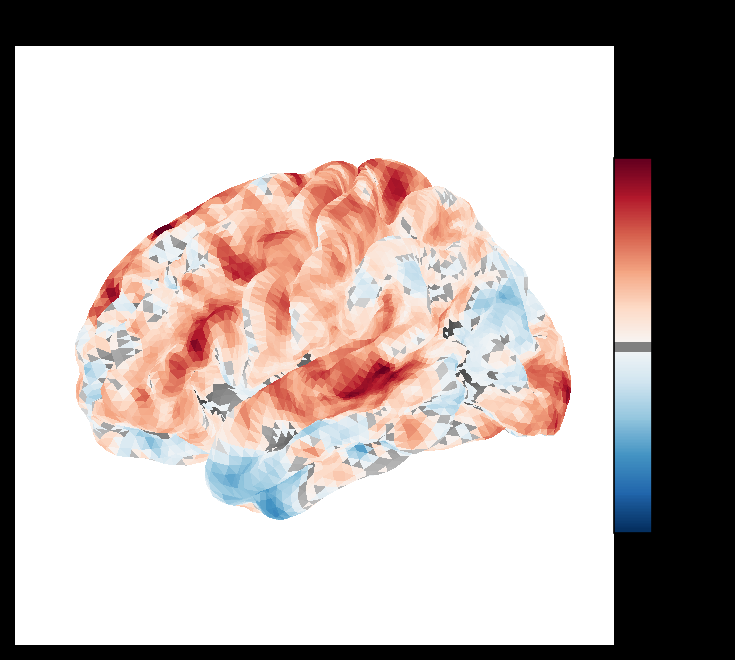
Post-Orienting
High Agency (reference)
The post-orienting brain told two different stories depending on the region. Body-related regions ~ motor, somatosensory, insula ~ didn't just recover toward high agency. They overshot it. Motor cortex hit +0.110 (vs HA's +0.109). Somatosensory hit +0.085 (vs +0.083). Insula hit +0.034 (vs +0.033). The physical machinery of agency came roaring back in three minutes.
But cognitive regions told a different story. ACC/salience recovered only 39% of the gap. dlPFC recovered 41%. Temporal/language recovered 54%. The executive systems that enable clear thinking and directed action were partially restored but not fully back online.
| Region | Overwhelm | Post-Orienting | High Agency | Recovery |
|---|---|---|---|---|
| Insula | +.027 | +.034 | +.033 | 131% |
| ACC/mPFC | +.038 | +.049 | +.066 | 39% |
| dlPFC | +.044 | +.060 | +.083 | 41% |
| DMN | -.045 | -.028 | -.007 | 44% |
| Somatosensory | +.070 | +.085 | +.083 | 121% |
| Motor | +.081 | +.110 | +.109 | 104% |
| Temporal | +.090 | +.113 | +.132 | 54% |
| Post. Parietal | +.024 | +.048 | +.050 | 91% |
Three minutes of orienting ~ just slowly looking around ~ predicted a dramatic but asymmetric recovery. The body came back first. Motor cortex, somatosensory cortex, and insula all overshot high-agency levels. The physical substrate of agency restored rapidly and completely.
The cognitive systems recovered more slowly. The salience network (ACC) went from +0.038 to +0.049 ~ significant progress but still well short of high agency's +0.066. Executive control (dlPFC) showed a similar partial recovery.
This maps onto what we'd expect: orienting engages the ventral vagal system, signaling safety to the brainstem. The body comes back online fast. But the directed, clear-thinking quality of high agency ~ the "what matters is getting out" stance ~ requires something beyond regulation. It requires cognitive reorientation toward action.
This suggests a two-step model. Regulation restores the bodily machinery of agency ~ the motor readiness, the interoceptive awareness, the physical capacity to act. But full agency also requires the cognitive direction: clear problem definition, resource assessment, sequential action. The body is the prerequisite. The direction is the differentiator.
Caveats
These are predicted activations from a model, not direct fMRI measurements. TRIBE v2 is impressive, but it's generating predictions about what brain patterns might look like, not measuring them. The TTS voices are synthetic, not recordings of actual people experiencing these states. The model may be responding to prosodic features (speech rate, pitch, pausing) as much as semantic content. Sample size is n=1 per stance.
What the data can tell us is that different agentic narrations of the same scenario produce measurably different predicted neural patterns, and those patterns align with what clinical and theoretical frameworks would predict.
The regulation experiment used my actual voice (not TTS), which TRIBE v2 has shown stronger interoceptive cortex responses to in previous testing. This is a meaningful difference ~ the co-regulation effect of a practitioner's voice is something we plan to investigate further.
Next steps: testing more regulation protocols, running with real human voice recordings for the stance narrations, and potentially validating against actual fMRI data.
Method
Experiment 1 (Five Stances): Five narrations of a locked-room scenario were written to embody distinct agentic stances: vague, rumination, analysis (midwit), overwhelm, and high agency. Each was converted to speech using Google Cloud TTS. Audio was fed through Meta's TRIBE v2 model (pretrained on HCP data, 181-region parcellation, 20,484 cortical vertices). Predictions were averaged across time segments and grouped into eight ROIs. Brain surface maps were rendered using nilearn with the fsaverage5 mesh. Difference maps subtract each trap's mean activation from high agency's.
Experiment 1b (Narration Control): To control for regulation language embedded in an earlier version of the high-agency narration, we tested a neutral version containing no somatic or interoceptive content ~ purely cognitive assessment and action bias. This neutral narration produced the highest activation of any condition across all eight ROIs, confirming that the agency signal is driven by cognitive-behavioral stance rather than regulation vocabulary. All numbers reported use the neutral narration.
Experiment 2 (Regulation): The overwhelm baseline from Experiment 1 was followed by a 3-minute orienting protocol (actual voice recording, not TTS). A post-regulation re-engagement narration was then generated via TTS ~ the same person re-approaching the locked room after orienting. Recovery scores measure what percentage of the overwhelm-to-high-agency gap was closed by the regulation intervention, per ROI.
- Model
- TRIBE v2 (Meta)
- Training Data
- HCP (1,758 subjects)
- Parcellation
- 181 regions, 20K vertices
References
- Défossez, A., et al. (2024). "TRIBE v2: Brain Decoding from Speech." Meta AI Research.
- Van Essen, D.C., et al. (2013). "The WU-Minn Human Connectome Project: An overview." NeuroImage, 80, 62-79.
- Porges, S.W. (2011). "The Polyvagal Theory: Neurophysiological Foundations of Emotions." Norton.
- Craig, A.D. (2009). "How do you feel ~ now? The anterior insula and human awareness." Nature Reviews Neuroscience, 10(1), 59-70.
- Raichle, M.E. (2015). "The Brain's Default Mode Network." Annual Review of Neuroscience, 38, 433-447.